
January 22, 2012
Since 1974, when the first food pyramid was appeared in Sweden, triangular or pyramid-shaped nutrition guides have been used by 25 other countries and organizations. I found a great graphic over at Huffington Post that depicts some of the more popular food pyramids from around the world, and although America now uses the MyPlate design many countries around the world still use a food pyramid to dole out nutrition advice.
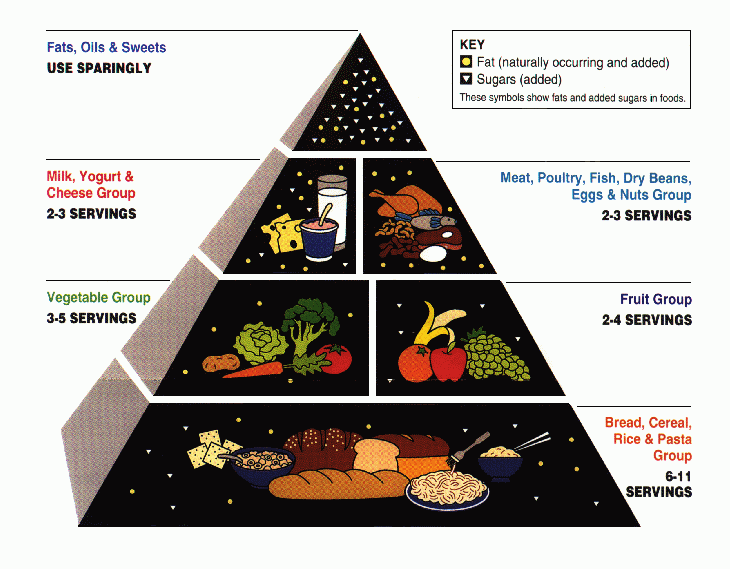
In 2011, the USDA Food Pyramid (pictured) was with replaced with MyPlate, which is very similar in terms of nutrient percentages.
Interestingly, a consistent pattern in food pyramids around the globe, from China's Food Pagoda to Greece's Food Pyramid, is the appearance of cereals, grains, bread, pasta and other starchy carbohydrates as the base of the diet – and fats near the top of the pyramid, as a “use sparingly” category.
But this type of pyramid can lead to health problems. After all, dietary fat from healthy sources has been shown in studies to actually help to increase weight loss, reduce heart disease risk, lower blood sugars, lower cholesterols and maintain proper brain function (especially in kids).
And if you listened to my interview with Dr. William Davis, “The Shocking Truth About Wheat”, or my interview with Paul Jaminet about the Perfect Health Diet you learned that consumption of carbohydrates can cause serious issues with everything from weight gain to fuzzy thinking to heart disease.
But the issues don't stop with the predominantly “high carb, low fat” recommendations of most food pyramids. Frequent consumption of featured and recommended foods such as commercialized modern whole milk and hamburger has been linked to heart disease…
…dairy is extremely overemphasized – although calcium is important, many vegetable and meat sources contain plenty of calcium with a lower number of calories….
…there is no differentiation between “good proteins” and “bad proteins”, “good carbs” and “bad carbs” or “good fats” and “bad fats”…
…and the minimum serving of fruits is 2-4, which is a great way to send your blood sugar levels on a roller coaster ride all day long if you're not careful.
Furthermore, when it comes to the American food pyramid, we've barely scratched the surface of how food and agricultural institutions can exert lobbying and political power on the USDA to feature and prioritize subsidized industries such as dairy, corn and wheat as heavily featured or highlighted recommendations (a great book to read more about these shenanigans is “Food Politics“).
So what should a good food pyramid actually look like?
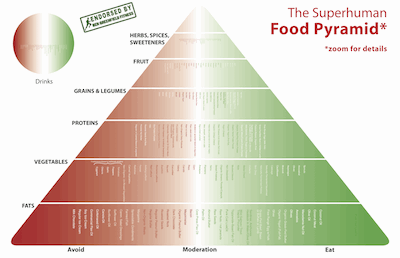
Although I have yet to be convinced that a food pyramid is the best, most functional way to dynamically depict dietary recommendations, I've decided to act on hundreds of requests from readers and listeners and create a “Ben Greenfield Endorsed” food pyramid.
I call my new design the “Superhuman Food Pyramid”, and this new food pyramid address all the issues above, ties in my personal nutritional philosophies that I've expressed many times in blog posts and podcasts, and also gives you a spectrum of choices from “Eat” to “Moderate” to “Avoid” for each food group, so that you don't have to deal, for example, with “Fats” lumped into just one category, or “Proteins” just lumped into another category.
To make it easier to practically apply my Superhuman Food Pyramid to your diet, I've also included several pages listing each food category and the Eat, Moderate, and Avoid foods within that category, so you can simply print, grab and go to the grocery store or farmer's market with your Superhuman Food list.
You instantly get my Superhuman Food Pyramid for free when you click the button below and share on Twitter or Facebook. [Note: Your timeline/feed must be public for our system to verify your post or tweet].
If you have questions, comments or feedback, just leave it below.
Good day Ben, I bought your book Boundless and I am trying to download and find the food pyramid, with no success.
There is no reference of the food pyramid in the book.
Look up “superhuman food pyramid pdf” on Google or Bing.
Hey Brother, I’m more than happy to post on Social Media for you, but I don’t see the link to do so?.
I would absolutely Love a copy of your food pyramid! If you could email it to my email that would be absolutely amazing!
I did not receive the food pyramid in any way, is it still available?
Also tried…. really want a download of this Pyramid.
Look up “superhuman food pyramid pdf”
What an outstanding post, thank you so much for rising this serious matter.
Being deeply reassured that many of people would talk about your views, I showed your writing into a friend of mine.
And that’s when the arguments started… We have different views but, needless to say, no issue, be it just
something routine or really important, should destroy a true friendship.
In my humble opinion, which certainly has the right to
exist, the very purpose you have made cannot
be contested.
Hello Ben – arrived here after purchasing and watching your creative live course;
Don’t have social media ; can I request this emailed please and thank you!
Hi Ben, thank you very much for this food pyramid, this is exactly what I was looking for. I see that it was published years ago. Do you still stand by it fully? Or do you have a more updated list/pyramid?
Still relevant!
I paid with a tweet (Facebook post, actually) and now what? I’m reading you book and would like this info but I don’t think the system is working. Can you email it to me?
Pay with a tweet doesn’t work. @oldphilthy
It appears to be working now. I would try again and if it's still giving you trouble email [email protected]
Ben,
How does one get this food pyramid without having a twitter or facebook?
Watching your creative live course and you state this pyramid is available for free in the course along with stating a lot of other stuff is available for free at your/CreativeLive subpage.
Why isn’t any of this stuff free even though you promise them free to the audience and viewers?
Is there a way for us to get these resources without paying for them again?
Sorry, Josh, what exactly are you having trouble accessing?
Hey Ben – I just bought your creative live show and it says you can get the downloadable pyramid and grocery shopping lists for free. I see here that you can “pay with a tweet” and I’d prefer not to do that. How can I get them free free because I already paid by buying the class – thanks in advance!
I will have it emailed to you.
The pyramid is super interesting but I would’ve liked to know why some food should be avoided or eaten in moderation and others are recommended, for instance, raw nuts (thought they were great food!), why should we avoid sunflower oil?, why sweet potatoes should be «moderate» (superfood according to Dr Michael Gregger), why tofu should be avoided, etc…
Thanks!!!
Great question! This is exactly the type of question myself, my team of coaches and the community in my Inner Circle can help to answer for you.
The Inner Circle is a collective of people who are pursuing the same goals you are – trying to live a healthy, happy, adventurous, fulfilling and limitless life in a modern world. In the Inner Circle, we all help each other with questions, ideas, motivation, suggestions and much more!
Here is where you access that community: BenGreenfieldFitness.com/InnerCircle
If you prefer a more direct, customized approach, I'd be happy to help you via a personal one-on-one consult. Just go to https://bengreenfieldfitness.com/coaching. and then choose a 20 or 60-minute consult, whichever you'd prefer. I can schedule ASAP after you get that. Additionally, if I'm "out of your price range" (yes, yes, I know I can be a spendy guy to access) I have a team of coaches I've personally trained who can help you here: https://greenfieldfitnesssystems.com/product-cate…
I hope that helps, and I look forward to getting you everything you need!
Stupid nurds, be a vegan.
why?
Hi Ben; I was wondering if you could email me the food pyramid? I shared your and liked your FB Page but i can’t seem to get the pyramid! Thank you
Sesame oil Ben?
Cold, yes!
Here is a link that I found:
http://energytransformations.wikispaces.com/file/…
Shared to facebook. Can see it on my timeline. But didn’t get the pyramid info. Please send to my e-mail address. Thanks!
Hey Mary – your timeline needs to be public for it to work.
Of corse the food pyramid is wrong! Your not supposed to have that much bread, it isn’t even good for you unless your eating ancient grain bread and even grains shouldn’t be on the bottom of the pyramid. It’s all such a joke that the schools teach this to children.
Hi Ben, I would like to know your thoughts on edible fungi such as mushrooms as a food source in the pyramid?
I'm a fan. Especially Crimini and Shitake. Check these out:
http://www.whfoods.com/genpage.php?tname=foodspic… http://www.whfoods.com/genpage.php?dbid=122&t…
I agree. I’m more Paleo now. I actually try to avoid breads and pastas. I’m happy if I have a yucca and a deer steak. And an apple.
Hire a new graphic designer or if you made this thing – hire a graphic designer! It is virtually impossible to read.
Did you download the actual pdf or are you trying to read the low res jpg?
Also, did you zoom in on it? It was created by a professional designer who does this for a living.
Hey Ben,
You speak to me, but I do not have a twitter or facebook account. Call me caveman, how do I get a copy of your food pyramid, I have old fashion dollars. I am a personal trainer and enjoy the efforts of your work and research.
email [email protected]
Love the site, I like the natural funnel to this pyramid. Hooked on good content, now if I can change my diet. HA!
just readin this now, looking forward to seeing chart more detailed. i dont have twitter and dont see the link for facebook? happy to share. thanks!
Ben, I'm glad I came across your site and appreciate the information here. I especially found the protein supplement reviews helpful. I downloaded the updated food pyramid after sharing on Facebook. When you zoom in, the graphic gets larger but the print size of the text inside the pyramid did not seem to increase much. I had to zoom in very closely to see it, which makes it difficult to use. You might consider another format that makes it easier to print the document and actually see the text well, or just view it more easily within the PDF without zooming so much. Meant respectfully, and thanks again. Mike
Point taken. Thanks for the feedback!
Hi Ben,
Thanks for sharing this superhuman food pyramid..It would be a lot helpful upon my diet and exercise..
ayerz,
http://www.unleashyourthin.com/
I just couldn’t leave your web site prior to suggesting that I really enjoyed the usual info a person supply in your visitors? Is gonna be back regularly in order to check out new posts
Feel free to surf to my web-site: cheap car Insurance uk young driver
I am having problems getting the food pyramid. I have posted it (liked it) on my facebook but I am still unable to get the download. What is wrong?
check your computer/pdf. It should have automatically downloaded.
I posted a tweet and it still will not provide the pyramid.
we'll look into this asap.
The info is great, I like the way it's organized, but why is the print so stinkin' small????
You can download it and then use the Zoom function on your computer.
I shared it on FB. Where is it?
Ben I posted the comment on Twitter and got the message back "didn't see your tweet, try again …" and then texted "FITNESS" to 411247 and got a welcome message .. but no pyramid .. need some help here pls. Thx
I shared on twitter and didn't get to download?
Hi Ben! First of all, I love your tips, but I have a few questions:
How come some foods appear as don't eat in one category and eat/moderate in another?
I have an Ironman in 1,5 month, do you think I could make the switch now from medium fat/ medium carb diet to low carb/ high fat or wait until after the IM?
Also, what's the problem with tomatoes??
Thanks!
Is this offer still good? I just tweeted (twice) that I downloaded Ben's Superhuman Food Pyramid, but the message I'm gettting is that they haven't seen my tweet. Is there some other way to acquire this infographic? Thanks a bunch for all you do! (Twitter name is Meg Duncan Daniel.)
I tweeted and could not get the download either.
Interesting food pyramid from a health fanatic. Is the traditional pyramid actually encouraging poorer health?
Yes, definitely Stuart!
Interesting food pyramid from a health fanatic. Is the traditional pyramid actually encouraging poorer health?
Looking forward to seeing the Superhuman Food by Ben Greenfielld
dude. just include it. fuck twitter
Hey this is kind of of off topic but I was wondering
if blogs use WYSIWYG editors or if you have to manually code with
HTML. I’m starting a blog soon but have no coding knowledge so I wanted to get guidance from someone with experience. Any help would be greatly appreciated!
guy – this is crap..you post on facebook…it doesn't work…you try again and finally it does, and then your asked to download a bunch of BS software, toolbars, etc… much less of a fan after this… you need to figure out a better way…
shared it, went through the PDF downloader thing even though my security suite kept telling me not to then… nothing. Does it really have to be this difficult?
Hi! Do you know if they make any plugins to help with Search Engine Optimization?
I’m trying to get my blog to rank for some targeted keywords but I’m
not seeing very good results. If you know of any please share.
Thank you!
This is similar to the bulletproof diet by dave asprey. Nice work
This is the perfect webpage for anyone who really wants to understand this topic.
You understand a whole lot its almost tough to argue with you (not that I
really would want to…HaHa). You certainly put a new spin on a subject which has
been discussed for decades. Great stuff, just excellent!
Hey Ben, I shared this on FB and was surprised how many of my work mates started asking me about it. I've put them in the direction of your podcasts as I've told them they are loaded with information on nutritional for and training tips.
I'm only question is how do I get to download a readable copy of the food pyramid?
Thanks,
Paul C
Ben, Can I email you to get a copy of the Super Human Food Pyramid?
if you don't have twitter, facebook or a phone, then yes.
I would love to look at your Super Human Food Pyramid, but I do not belong to Facebook or Twitter (nor do I want to).
Is there any other way?
yes, text the word FITNESS to 411-247
No texting either. Only email. Sorry!
Just email me [email protected] and I'll see what I can do…
I'm very openminded about this, but I just read The China Study, which draws some EXTREMELY convincing links between animal product consumption and heart disease, cancer, and diabetes. Any thoughts? They push a 100% plant based diet.
Start here: http://rawfoodsos.com/2010/07/07/the-china-study-…
Hope that helps!
Ben
i've followed a strict plant-based diet for the past 11 years (and was a strict vegetarian for over ten years before that) and hope to go mainly raw in a few months. raw foods are amazing.
can I do the same?
never mind; just did it and got the pyramid!
Hi Ben, the food pyramid is great. I know its not an all inclusive list of items, but I noticed that grape seed oil is missing from the list. I use this quite a bit to supplement calories and fat when I need it and was wondering where this would fall on your list? I would expect that it would fall near olive oil, but I wanted your input.
Thanks!
In most cases, grapeseed oil should be used minimally, since it is a highly processed oil that ultimately does not hold many nutritional properties that an alternative oil such as olive oil, coconut oil or nut oils will have.
Hi Ben,
First time commenting, just recently found your site (Awesome) and I like this pyramid but was wondering why you put regular beans and legumes under the AVOID category? Does this include cooking your own dried beans? I was hoping you could elaborate a bit or point me in the direction of some research.
Thanks!
This does not count if you are soaking (and preferably sprouting) your own dried beans UNLESS you need to fix your gut or have autoimmune issues…
I don't have a twitter or facebook account and I don't want one. But I'd love to see and have a copy of your pyramid.
I enjoy your podcasts – very informative!
Then just text the word FITNESS to 411247
Dear Ben,
We listen to and enjoy your podcast series. We particularly like the way that you are balanced and hear all points of view and let your audience make up their mind, to see what suits them individually.
The last one struck a chord with me, as I have been successfully treating old injuries for 10 years now, by hand the old-fashioned way, because it works. Your fabulous triathlete describing how he has to live with his old wrist and Piriformis injuries surprised me a bit as I have heard that physical treatments are much more available in the US than they are in Europe. I would love to be part of your show and describe how people can get these things fixed. I realise that I am in Europe and your audience is mainly in the States, but I have been developing ways to teach people to treat themselves because I have the same problem, many of my followers are in America and this is why I have seen the necessity to try to serve those who cannot get to me. I hope to start a small revolution! It is possible to address many issues yourself. I have discovered this through failing to find anyone who works the way I do to treat me, so I have been working on methods to tackle issues myself.
I have done this on the radio before!
Please get in touch if this appeals to you.
Best Wishes Catherine Holland.
hey how to gain mass and increase body shape without any supliment.
Thanks, Ben. I'm new to your site, and happy with everything I am seeing. I am an endurance triathlete, is the pyramid designed for endurance athletes, regular joes, or both?
Both Jason. As a matter of fact, an adaptation of it is what I used to write the nutrition program in http://www.lowcarbtriathlete.com
Limit the fruit? People are getting heart disease and weight gain because of eating too much fruit?
no. no, they are not. fruit is amazing for you. my vegan self who has spent years in a nutritional epidemiology lab and has a degree in vertebrate physiology begs to differ on anyone saying a bad thing about fruit.
fruit is amazing for you.
If carbohydrates can cause serious issues with everything from weight gain to fuzzy thinking to heart disease, how come Dr.Doug Graham doesn't suffer from any of these and he's been on a high carb low fat diet for 30 years now? How many people do you actually know that are fat because they are eating too many potatoes?
Why isn't chicken and turkey on the pyramid?
Oversight. It will be on the next edition…
I am having the same problem as people above: shared the link on Facebook, but have no idea how to get the larger version of the pyramid. I would really like to see it. Plus, I wish Ben had an email contact. oh well, looks like he is doing good work.
did you use this link? http://www.paywithatweet.com/pay/?id=a368e66a21ba…
I cann't makeout or down load the pyramid.
Just a suggestion, next time you could place in a separate section the recommendations for those having allergy problems. You saw in fact many people asking "why this food in moderation" for foods that are excellent, nutritionally speaking. For instance you place strawberries in the moderate section but mango in the "eat" section. I suppose this is for the fact that strawberries are more likely to cause allergies, because otherwise it would not make sense, they are rich in a number of nutrients and far less sugary than mango.
But really, people can be allergic to virtually everything. You cannot mix what is good nutritionally to what you should avoid only because some people have allergies to that. They are two completely separate chapters, and those with allergies usually consult a specialist for foods to avoid.
Actually, strawberries are higher in pesticides and herbicides. They're one of the "dirty dozen". The difference in sugar between equal serving sizes of mango and strawberries is pretty minimal. It's tough to make a food pyramid that takes into account allergies, because they're so variant.
What if I don't have FB or Twitter?
Ben,
I don't recall hearing this from you, but I haven't completely listened to every podcast yet… Why is almond milk in the avoid? I know you probably mean the commercial variety here rather than the make it yourself, but is the commercial stuff really that bad? I drink it every day. I live in a state where they ban the sale of raw milk so I have no where to get it. I do buy coconut milk but don't like the taste of it so I only use it on occassion for smoothie or blend with protein/greens powders. Can't stand the unsweetened straight and won't buy the sweetened.
Isn't almond milk in the "moderate"?
Hey Ben,
Very intriguing pyramid. I have a ton of questions…mostly about why certain foods are on the avoid list. Will you cover this in more detail in your podcast at some point or should I dump my questions here?
Yes, or you could go listen to all the previous podcasts where I've talked about this before. ;) But in a nutshell, yes, I will be covering in much more detail eventually. For now, just do it!
find a local farm where you can “buy” into a herd share and get raw milk that way. http://www.realmilk.com/real-milk-finder/
I was very surprised to see Onions, Garlic, Peppers & Tomatoes on the "avoid" side! I currently eat loads of these :-(
Should these be avoided even though I do not have an autoimmune disease and am not nightshade sensitive? If so, what is bad about these vegetables?
lol. For the gazillionth time in this comment thread – only if you have autoimmune or nightshade sensitivity.
I'm trying to post from my iPad and it doesn't seem to work. I choose download and it says I need to post.
hmm…did you try both facebook and twitter?
did you try both Facebook and Twitter options?
Ben:
Very thought provoking pyramind. In addition to questions about fat free (as opposed to fat containing) yogurt, and some of the other questions above, what about edamame? And where do the various milks (cow's, goat's, soy, coconut) fit in? Also wondering what roasting does to nuts to make them bad. I know a lot of these questions are dealt with elsewhere on your website and podcasts, but it would be helpful to have a synopsis of your thoughts on these questions, as well as a brief sentence or two explaining why each item in the pyramid is in the "eat," "moderation," or "avoid" categories. I'd certainly pay for a booklet with those details. Would be nice to have as a reference, for myself and when talking to others about nutritional issues. Thanks, and keep up the great work. Nice to see you trying to back up your selections with studies.
Edemame is not fermented, so lots of phytic acids, which inhibit digestion. See "drinks" section of pyramid for milks, etc, and read comment earlier in this post about nuts and roasting vs. raw. I will eventually have a more comprehensive synopsis…
Getting the hang of your website. Learning how to post and pay attention to your replies to other posts. Sorry for the redundancy. Thanks for the patience. Great info!
What about fermented soy products? I’ve read they are the only OK soy food to regularly consume. Also, why no organic fat free/low fat yogurt? Thanks, Ben!
Nevermind, I see you put fermented soy under moderate. My mistake.
Yogurt without fat is mostly just sugar with some protein. Eat foods in natural form whenever possible. BTW, are you Josh Cox the marathoner?
Ah, I understand now. Thanks. And no, I wish, just a namesake who also happens to do endurance sports.
Hey Ben, You didn’t mention Spinach? I thought it would be ranked next to Kale or is it not consider a superhuman food. I like to use alot of spinach for salads. Keep up the good work man
hmm…spinach should certainly be there. I'll check.
I couldn't get it to work from Safari, but FireFox worked fine.
Same problem. I posted it on FB twice, but the download did nothing. Is it "wrong" to ask someone to just e-mail it to me – I really did post it to FB.
See what Dan Lombardi said.
Ok, if anyone is having issues still, copy this to your Facebook wall.. its basically doing it manually, you will then be able to click on the link on your wall and view the pyramid and share w/ others.
http://goo.gl/UqgYo
Ben, love the pyramid, thanks again for your efforts. I completely agree with what you have put together, I have been seeing a Nutritionist for 6 years now, he specializes in Metabolic Typing and Blood type diets, and his plan for me is VERY similar to what you have here.
PS – Avocados is on there twice, once misspelled as "avocadod".
Dan L.
Thanks for the Facebook and the Avocado tip Dan!
It appears I'm not the only one having trouble with FB and getting the pyramid. Tried it 5 times??? Any suggestions
Hey James! Did you hit the 'download now' button then the FB button?
I now see the button to Post to FB, but when I do that, it worked once and nothing came up. I clicked on Download and it says you must post to FB first… Now when I click on Post to FB nothing happens. Hmm…
Hey Ben, I’d love to view the pyramid but I only see an option for Twitter (which I do not use). I’d post to Facebook but do not see an option.
Thanks,
Dan L
Superhuman…hmm but then where are the different types of Kryptonite? :P Just kidding, I’m sure it rocks, will download as soon as I get home:)
Hey Ben, Thanks for the GREAT info. I retired from the California Air National Guard a little over a year ago. I gained 25 pounds of dead weight over the past year, but with good info like this, along with your podcasts and busting my butt I'll be back in shape in no time!
Thank again Ben!!
Any download options for those of us not on Twitter or Facebook? Thanks.
You have any other way of sharing it David?
Same here…don't use FB or Twitter…won't use FB or Twitter. This is a well-used internet marketing and traffic generation method that Ben's used before. It does leave a segment (probably larger than realized) of us loyal followers out in the cold on things once in a while.
Sharing? I tell everyone I know about Ben and the things I've learned from him. No gimmicks needed. Advertising doesn't get much better than true unsolicited word-of-mouth from people you actually know and trust.
I don't mind missing out on things once in a while. Ben has given a lot…and in return I've purchased a lot from Ben, both out of respect for his contribution to my life as well as the fact that what he has is good stuff, from his digital products to his suppliments and hard goods.
As long as I don't feel TOO left out, I'll stick with you, Ben!
Very well stated! I too will not use FB or Twitter, so I guess we are left out occasionally … that said, I agree that Ben is still the best resource on the internet.
You also get it if you’re in the VIP Text Club – text the word “Fitness” to 411-247.
Hi Ben. Thanks for posting pyramid! Question: Why so down on roasted nuts? Does roasting nuts cause them to become higher in fat? I noticed you put raw nuts under 'moderate' and roasted nuts/seeds under 'avoid'. If I buy raw almonds and roast them myself, adding no new ingredient in the process, do they still move from 'moderate' to 'avoid'? OR, did you mean to not buy almonds, for example, that are pre-roasted and sold that way. (With a bunch of other seasonings added).
Essentially, why have you placed the roasted version of raw nuts put under the 'avoid' category?
Thanks, as always,
Anita
Anita, why on earth would I tell you not to eat roasted nuts because roasting causes them to become “higher in fat”? I just told you fats are good! I’m not trying to be harsh, I just really want to make sure you understand that it’s very rare that I recommend avoiding something because it’s “high in fat”.
It’s because the roasting process increase free radical formation. Anytime you heat a seed or nut based oil, it increases in rancidity, whether you roast them yourself or someone else does. Low heat only for nuts (i.e. a dehydrator).
Hey Ben, i did not mean to imply that YOU had indicated that roasting nuts causes them to "become higher in fat"… that was my taking a stab at a potential reasoning for roasted nuts being placed under 'avoid'. Evidently, i was wrong. No worries, got it now, roasting = increase in free radical formation… thanks.
looks great, but does not seem to respond to facebook
try again!
Hey Ben! What do you consider a serving size for the different groups on your pyramid? Thanks for putting this together. It looks like a great resource.
Totally depends on your size and activity. That’s why I don’t have serving size on there.
I admire you Ben for putting yourself, thoughts and ideas out there. People always nit pick when a new idea comes up. Thank you for putting yourself out there. Your ideas and instructions are helpful and look forward to hearing more.
Hey Ben,
The link doesn't seem to be working for FB. I have tried to post it but nothing happens. I then hit the download button and it tells me I have to post to FB first. So I hit the post to FB button again and nothing…. Any suggestions?
Worked for me on Facebook…. Do you have pop ups blocked?
try it again.
I've posted to FB but I can't seed to get the download either. Suggestions?
i love that this is soooo close to how we eat. a couple tweaks and we're already following the pyramid. THANKS Ben!! You rock!
I shared it on FB. Where is it?
You need to make sure you share using the button at the end of the post…
try again.
What a joke BG. This will make a fun youtube video response.
Ben Greenfield thinks cucumbers and lemons make you fat along with red leaf lettuce but fried beef tallow makes you lean and healthy? LMFAO!
Are you serious bro or just taking the piss?
you so dumb, durianrider
Thats what I was thinking. I was getting some good information out of his material but than I looked at this and i was like whoa
Hey Durian rider, I know I’ve had a go at you before, but legit just wanna learn.
Would love to see a video response on this. Given you wrote that 3 years ago, I’m sure you’ve done one already, if not…..would be great to see something where you don’t just bag the guy out and swear nonstop.
I dont mind swearing, I do it myself, but the way you attack people is just plain silly……..I love hearing debates, and the podcast ep where Ben interviewed you was one of the most enjoyable things I’ve heard on the internet in my lifetime.
I wanna hear/see more of that durianrider. The durianrider who looks at things with an open mind and a critical view, and who respects people for their knowledge, but uses science to show his disagreeing, not just saying “this guy’s a total flog, got no idea,” etc etc.
I see you as a great resource, man. But you’ve let me down a lot.
Like, where does Ben say cucumbers and lemons make you fat? Maybe he said some carbs make you fat (but even that would be oversimplifying), but just because cucumbers and lemons have carbs (although, not many, unless you eat kilos of em) doesn’t mean he’s saying those foods are fat. Even if you think Ben is a “disciple of the low carb religion”, than claiming he says lemons are bad, when lemons are one of the lowest sources of fructose in plant foods……..sounds pretty nonsensical to me.
As for fried beef tallow making you lean and healthy. Why not? If fat makes you fat, I’d like to know how, and hear it from you. Can you explain the precise metabolic pathways that lead fat consumption to fat storage? And if you go with the “individuality, dude, everyone is different”, can you describe exactly how your body would deal with it, all the ins and outs, all the physiological intricacies (ie. not just “fat makes you fat, end of story, budda bing budda boom”)?
As for asking if he’s serious……….I have a couple of good mates who actually have disabilities, so I don’t want to go down that path……….but it does beg the question of how many years ago any morsel of intelligence lodged in your brain left your body (I say lodged, coz it implies it got stuck, like, it doesn’t belong there). If he wasn’t serious, why would he bother making a blog post about it, interviewing other blokes, or not say at the end “hey guys, was only pulling ya leg, was all bullshit”?
Do you have any sort of education????
Mate, I’d like to meet you. Genuinely, I’d like to have a one on one conversation about nutrition and exercise with you. You can catch me anytime at the 47th best university in the world, in the top 2% for exercise and sport science, aka, Deakin University in Melbourne’s east.
Would love to have a kick of the footy with ya.
You seem like an alright bloke. Some of the time.
I just really think your videos are stupid, not the content or the message you deliver about plant-based diets and eating healthy, but the way you go about it. It’s just plain stupid.
I can’t fathom how any human being can talk the way you do.
And this is where you really let me down, and the whole country, the greatest country on the planet. You’re making Australians look really really really REALLY bad!!!!!
To me, durianrider, you’re the equivalent of the typical schoolyard bully (but without all the muscles…….or any of the muscles……..)
You seem to be somewhat damaged internally, and when people who are doing great things, that you don’t like, you just try and put them down to feel big (not that you’re big at all, physically or othewise), like Shane Watson on his high fat diet (the man tonned up in a 20/20 the other week!), or guys like Tim Noakes, looking to fix his problems by NOT doing the same thing (high carb diet) – I believe Einstein defined insanity as doing the same thing and expecting a different outcome.
Even the guys you sometimes, RARELY reference in your video (john mcdougall, neil barnard) don’t see Peter Attia and Ben Greenfield as complete flogs. They don’t see them as jokers and idiots. They just have a different view on what the majority of the world should eat. I’m sure the fact that these guys are all highly educated, and thus they have that in common, means something. With everything Ben has done in his life, his experience in body building and endurance racing, his tertiary education (tertiary means third, by the way, as in, of third order…….primary school, high (secondary) school, uni (tertiary) ), he was ranked the best pt in possibly the most important country in the world, for god’s sake!
What right do you have to have uncultured digs at these guys?
I really pity you. I’m sure you’d beat a snake’s belly at limbo.
Not that I have a great knowledge in clothes shopping (I am a bloke, after all), but you need to get some underwear to cover up that thing on ya head.
Yup, I shared on my FB too–but where do I download the chart? :_)
At the end of the process you should have received a link to download it from.
Drat. I never saw it. I did see the link for the chapter (which I did download).
E-MAIL [email protected]!