
January 20, 2012
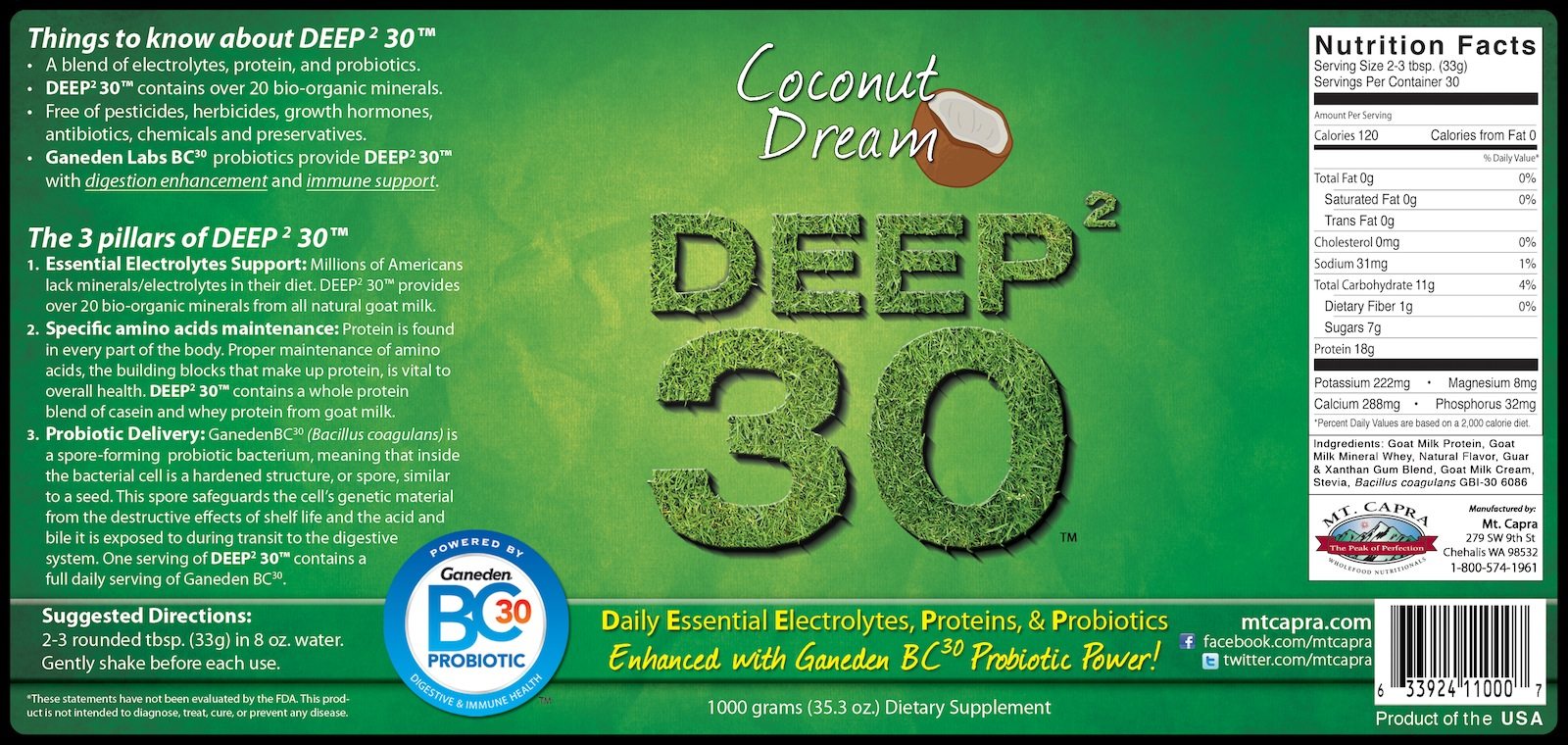
Click on this image to see the ingredient label for DEEP 30 Coconut flavor – an example of a protein powder that isn't going to kill your insides.
Click here for the full written transcript of this podcast episode.
If you're wondering how to choose protein powder, this article will help you, because I'm going to teach you about 4 protein powder mistakes you probably don't know you're making. Be sure to download and listen to this protein audio interview too.
Let's start with a quick exercise:
Take a look at the ingredients of the protein powder above (called DEEP30). You can click on the image and read them, or just read below:
Goat Milk Protein, Goat Milk Mineral Whey (electrolytes), Guar/Xanthan Gum Blend, Goat Milk Cream, Stevia, Bacillus coagulans GBI-30 6086 (probiotics).
Got it?
OK, now check out the ingredients of probably one of the most popular protein powders on the face of the planet – EAS Myoplex:
Whey Protein Concentrate (Whey Protein Concentrate, Soy Lecithin), Corn Maltodextrin, Natural & Artificial Flavor, Salt, Whey Protein Isolate, Carageenan, Xanthan Gum, Acesulfame Potassium, and Sucralose.
The difference between these two proteins may seems slight at first, until you take a closer look and see:
1) You Can Make A Mistake With The Protein Source.
The whey protein concentrate source in EAS Myoplex is from cow protein, but the protein source from the DEEP30 is from goat protein. Compared to cow's milk, goat’s milk is less allergenic, naturally homogenized, easier to digest, lactose intolerant friendly, and biochemically and thermodynamically superior to cow’s milk.
I cover the issue with cow's protein in detail in the episode “Cow's Milk vs. Goat's Milk”. In addition, compared to cow products, goat products contain less or none of the growth hormones or antibiotics that massive cow dairies have come to rely upon to turn a profit.
2) You Can Make A Mistake With Added Ingredients Like Soy & Corn.
The EAS Myoplex adds a soy lecithin extract – an “emulsifier” in many foods and supplements that helps the components mix together more thoroughly. Unfortunately, not only is 91 percent of soy grown in the US genetically modified, but soy contains natural toxins known as “anti-nutrients”, a clot-promoting substance that causes your red blood cells to clump together (hemagglutinin), substances that block the synthesis of thyroid hormones (goitrogens), mineral absorption-blocking phytates, plant based phytoestrogens that may cause infertility and may promote breast cancer in women, and high levels of toxic metals aluminum and manganese. I've found that protein powders without the soy lecithin tend to clump slightly easier, but do just as fine if you put them in a blender or shaker.
The corn maltodextrin in the EAS Myoplex is not present in large amounts, but it's a completely unnecessary added carb from another highly genetically modified source. If you want to have carbs with your protein, just toss in a banana – you'll get the fiber benefit with none of the genetic risks.
3) You Can Make A Mistake By Not Checking the Sweetener.
If you take a look at what is actually used as a sweetener, you'll see that EAS Myoplex uses acesulfame potassium, a derivative of acetoacetic acid that has produced tumors in lab animals, and sucralose, a chlorinated sucrose derivative that has been shown to kill up to 50% of the good bacteria in your gut.
In contrast, Mt. Capra's DEEP30 uses a completely natural and safe root-based sweetener – stevia. Personally, I lived on stuff like EAS for years in college and as a bodybuilder and you don't realize how much you were burping up chemicals and nasty fuzzy-thinking and stomach distress until you quit eating it and switch to something natural.
4) You Can Make A Mistake By Stopping At Just Protein.
When you listen to today's audio episode with Joe Stout, a food scientist at Mt. Capra nutrition, you're going to find out the benefit of going above and beyond just protein. EAS Myoplex stops at protein. DEEP30 also includes electrolytes and a probiotic strain called GanedenBC30, which can literally heal your stomach, eliminate abdominal pain and bloating in patients, and strengthen the immune system.
The end result is that you don't feel like you're constipated and bloated a couple hours after you've had your protein shake – and you literally are building a healthier gastrointestinal tract every time you eat your protein. You can also learn more about probiotics in this other interview with Joe: All About Protein, Enzymes & Probiotics.
So here's a quick review:
When you choose a protein powder, look for an organic protein source, zero soy or artificial sweeteners, and added ingredients that help you digest the protein.
I've been using DEEP30 for about 3 weeks now. It tastes a bit like a Wendy's Frosty and far better than Mt. Capra's previous protein powder (Double Bonded Whey). It also results in zero chemically burps, bloating, gas and constipation like other proteins do. I keep all three flavors (Banana, Strawberry and Coconut) in my pantry and just cycle through all three flavors, mixing them with either coconut milk, kefir or yogurt.
If you get a chance to try DEEP30, or you have other questions, comments or feedback about protein powders, leave them below.
What are your thoughts on Four Sigmatic’s plant based protein? I am looking to lose body fat and wanted to up my protein uptake. I am also adding Kion’s amino acid powder to my diet.
Hi Ben. I see you’re on the Advisory Board for Mt. Capra. I’m looking for some protein powder that doesn’t have any sweeteners (including stevia), and I know their products have some. They have a bunch of different products that vary slightly (e.g., whey protein concentrate, goat milk protein (whey + casein), and whey protein isolate). Of the three, would you recommend the whey protein concentrate as a workout-based protein (peri and post workout) and then goat milk protein for other protein meals outside of the workout?
Thanks for your insight.
Hi Ben,
My husband and I just turned 70 years young. Most people think we are in our 50’s. My husband does construction work every day 5 days a week. he is on blood thinner cholesterol medicine and blood pressure because he had 2 stints put in 3 years ago. Doing great! He has never had trouble with his heart nor had a heart attack. Hardly ever taken medicine in his life. If he had it to do all over might have gotten a 2nd opinion. As he’s alwaysm been healthy and active. I sometimes think these stints put in veins or arteries is like they use to do with tonsils,adenoids, and appendix. There was a time they always took them out now they try not too thinking the body needs them. None the less that is where he is at and once in the system everyone gets the 3 meds he is taking now. We want a protein drink or powder to gain more energy and keep our health up would Try Deep 30 be good for us?
Check out this: https://bengreenfieldfitness.com/2012/07/natural-… https://bengreenfieldfitness.com/2014/02/11-anti-… https://bengreenfieldfitness.com/2016/05/the-fitt… https://bengreenfieldfitness.com/2013/07/how-to-c… https://bengreenfieldfitness.com/2015/12/how-to-u… https://bengreenfieldfitness.com/2015/12/what-are…
As for products: https://greenfieldfitnesssystems.com/product/anti…
And…
For more, I'd be happy to help you via a personal one-on-one consult. Just go to https://bengreenfieldfitness.com/coaching. and then choose a 20 or 60 minute consult, whichever you'd prefer. I can schedule ASAP after you get that.
Hi Ben,
What is your take on Dr. Gundry’s position that ALL whey powders contain unacceptable levels of IGF-1, not to mention being A1 vs European cows (A2). I’m guessing that he’d be fine with Deep30, which I do use, which being derived from goat is A2 casein and thus more bio assimilated by our GI. He has a plant based protein powder called ProPlant which is spirulina, flax and hemp. Might make for an interesting interview, no?
What I’ve found interesting is that most have more than desirable amounts of “Cholesterol”. For someone who is trying to lower their LDL from 181 (which I really don’t consider high) why would you compound the existing situation when you’re thinking your doing your body well? The higher Sodium content baffles me. Not to mention the consideration of “plant based” protein powders were that much different with the sugar, sodium and even Cholesterol. I just don’t get it. If you are mixing these powders with Bananas and other fruits and such why is there added sugars/or derivatives? Are there any healthier protein powders out there without this stuff?
This is definitely a clean and healthy protein powder. I'd have a read through this: https://bengreenfieldfitness.com/2012/02/why-fat-…
Nice points
Nice point about the soy! Another reason you don't want soy in your protein powder is how it mimics estrongen, which for anyone trying to build muscle would be the exact opposite of what's wanted!
Hello Ben!
What are your thoughts about guar gum and xanthan gum? Doesn't it get in the way of the whey protein expected fast absorption in the post-workout period? I think it can interfere with our body's protein absorption/digestion, maybe we can talk about a loss of effectiveness for the whey product? I'm asking this because i would love to be able to add a little tablespoon of guar gum to the protein powder for extra thickness (it becomes so creamy and tasty) without having to worry about this loss of absorption/digestion of the protein content. The following study attempts to deal with this subject but nothing conclusive to me:
http://www.fao.org/3/contents/fb9ed43b-c060-5c03-…
Your thoughts on it, please? An extra little tablespoon of guar gum would ruin my protein shake on post-workout?
Thanks in advance! Keep up the good work!
Decreased protein digestibility is certainly an issue with added guar gum and xanthan gum, as the study you've shown highlights. The question is whether or not this is very significant once you're getting dosages of 20-30g, which is typical. If it were me, I'd play it safe and NOT add thickeners like this…but you could, for example, just add a little full fat coconut milk. That's what I do.
Thanks Ben!
I think you're right, it's better to go slowly on these thickeners like guar and xanthan gum. I will try to use them only in the off days of my training schedule and keep it at small quantities. Maybe it's not very significant but it's better to play it safe.
I'll try your suggestion of coconut milk for the Post-Workout shake!
Hello Ben!
I kept researching about it and look what I found:
American Journal of Clinical Nutrition (Study):
http://ajcn.nutrition.org/content/74/4/487.full
"(…) Guar gum did not significantly affect the bioavailability or utilization of dietary protein."
"(…) An important result was that the absorption, systemic availability, and utilization of dietary nitrogen remained unchanged after adding guar gum to a protein meal. (…) The present study therefore enabled us to reach a clearer conclusion than what was known before, showing that guar-gum-based viscosity did not impair the digestibility and efficiency of postprandial dietary nitrogen utilization and could only indirectly affect the efficiency of dietary nitrogen utilization, ie, through its effect on postprandial glucose."
So this is good news and i wanted to share with you, though in the study it also shows that it can affect urea urinary excretion.
Thanks for you attention.
Filipe Almeida
Deep30 and EXOS Whey were the two protien powders I was leaning toward. I just didn’t know if there was a big difference between the two or if was one was better than the other. I know you recommend both highly. I may have to try both. I will give CREO2 from Millennium a try. I have heard good things about CREO2 but I forgot about it. I will use that 50% discount code thanks for sharing it. Also thanks for sharing that podcast I enjoyed it. I have your book and have been following you for awhile on youtube and when you had pacific elite fitness so I may have to schedule a one on one with you sometime. Thanks for all your advice.
Hey Ben,
Can you recommend a good protien for me. I have played semi pro football and weekly I do heavy free weight training, high intensity sprints, and im about to start mixed martial arts and crossfit. My goal is to gain solid lean muscle mass and boost natural testosterone. My only concern is I want my protien to be all natural and have as many nutrients as I can get out of my protien. Im not vegean and I dont care what the protien is made out of as long as its natural and gives me the best nutrients.
Can you recommend the best protien that would fit my needs out of these protiens?
-Deep30,
-EXOS Whey Isolate,
-EXOS Vegan Pro Complex,
-Living Protien Vegan Complex
-Any other protien that would fit my needs
Here are some of the other supplements I intend to stack with my protien powder. Is there any other naturally organic supplement you think I should add to this stack to meet my goals of lean muscle mass and naturally increased testosterone?
-EXOS Amino Acid
-TianChi Adaptogenic Herb Complex -Natural Life Trace Liquid Minerals
-EXOS Multi Vitamin -Rosita Extra Virgin Cod Liver Oil
-NutraPro International High Vitamin Butter Oil (Grass Fed & Organic)
-NatureColostrum
– Creatine
Also can you recommend which creatine product is the best and naturally purest? Im trying to decide between these three creatines right now but im aslo open to any other creatines as well.
-NutriVitaShop100% Pure Micronized Creatine Ethyl Ester (CEE) HCL -PRO-Formulated
-SNI Creatine Ethyl Ester or XPI
-Decacor Creatine
-Any other creatine that would fit my needs
Thanks for your time.
You can't go wrong with either Deep30 or EXOS Whey Isolate. For Creatine I like CREO2 from Millennium Sports (50% discount MSTBG09). You also might enjoy this podcast http://www.mikemahler.com/blog/live-life-aggressi… and if you really want to dial this in (and make sure you aren't just creating some really expensive pee) you can book a one-on-one with me at https://bengreenfieldfitness.com/coaching.
I don't know what is the best protein powder? I have no choice.Can you please suggest for me?
Yep, I recommend either LivingProtein (vegan) or DEEP30 (whey). You can find both of them at https://greenfieldfitnesssystems.com
Hey Ben,
I have a quick question for you regarding protein powders. I cannot have whey, rice or pea protein due to IgG food sensitivities. However, soy wasn't reactive, so I might be able to do soy protein powders (not sure if it's the best choice). So, I would like to ask you for advice on what type of protein powder would be the best for me to use in this situation, and if you could recommend a specific brand?
Cheers!
I coached several people with autoimmune issues who do just FINE on the LivingProtein blend, as the processing deactivates the lectins in the peas and the other ingredients are very hypoallergenic. Only fermentation can deactivate enzyme inhibitors in soy, so I'd be careful with soy protein. I haven't found any "safe" brands vs. just eating natto for example. Interestingly, there are now fish protein powders. Also Onnit makes a very good HEMP blend: http://goo.gl/nfL8p and you can get CRICKET PROTEIN bars now…
What do you recommend blending with this and how much of the product should one consume daily. I.e I am 5'2 105 lbs. and usually replace breakfast with a shake.
Thank you
I'd recommend just one serving daily, and to get the rest of your protein from "real" food…fish, meat, seeds, nuts, etc.
When would be the best time to take Deep 30: before or after a workout or just as a daily supplement?
After the workout, 2 scoops!
Ben,
I just listened to today's Real Food Con presentation with Dr.Josh Axe. Great listen.
This brought be back to your site here to see what you had on protein powders. I am here in Canada and was wondering if you recommended a brand called http://myvega.com/product/vega-one-nutritional-sh…. Is this something you'd recommend if I can't order the Pacific Elite Fitness powder (I've already placed an order last month and have to cool it for a bit on my online purchases).
Also, is this something I can take everyday after my workouts, sometimes even twice a day? If not, are there any post workout alternatives to protein powders for on the go? I find now that I've eliminated protein powders from my routine, I am now rushing home after my workout to eat something with protein! It's stressful and I'd like to find a protein powder I don't have to worry about.
Thanks!
N
Vega isn't bad stuff, and while you CAN do it twice a day, don't get too "lazy" with your protein if you know what I mean. Make sure you learn how to cook too. ;)
I’d stay away from Vega – high in heavy metal contamination and they refuse to supply their COA (certificate of analysis) showing the results from their protein powders.
Can you suggest a protein powder for an 18 boy where taste is top priority also? Thanks to checking things out on line and finding you I will be returning the protein powder we just bought yesterday, first time buying protein powder, because it's crap. I checked into Deep 30 and am getting it for myself, but my son does not like bananas, coconut, or strawberries. Was looking for a chocolate one. I was looking at Mt. Capria – Double Bonded Protein- Whole Food Nutritionals. My son has recently lost 54 pounds and looks and feels great!! He has been working out the whole time, but is now REALLY trying to tone and build muscle. Thanks for any help!!
To be honest, most protein powders that are actually healthy and not filled with bad sweeteners don't taste that well. I've actually found mixing http://pacificfit.net/items/livingprotein/ with dark chocolate powder works really well!
What protein powder do you suggest for me? I cant do ant artificial sweeteners or stevia, I get sick and bad headaches. I have a sensitive stomach. I am new to cross fit and want to build muscle but stay low on carbs. Dairy free is good as well. thanks! :)
This one would be best fit for you Candace: http://pacificfit.net/items/livingprotein/
Thanks, I have been looking for something Dairy Free without any artificial sweeteners. I have gastro issues and my Dr. says absolutely no dairy or artificial sweeteners. I’m glad I ran across this.
Hi Ben, love your podcasts. It’s actually the first thing that comes on my tv in the morning. Can you tell me why the Deep 30 protein is so high in sugar and Carbs? And what sorces does it come from? Thank you:)
It is totally organic, cold processed goat whey protein and it's sweetened with stevia. There are trace amounts of goat cream in it, but still only 11g of carbs. That's low!
Hello Ben, I'm in UK and couldn't get hold on this Deep30 protein but I'm using ON Whey Gold Standard at the moment. http://www.optimumnutrition.com/products/images/1…
I'm really concern about the soy containing bit. Can you help me look into the nutrition fact and suggest me some goat whey protein products available in UK as I really want to try.
Thanks, cheers
I'd stay away from that stuff. Acesulfame potassium is a possible carcinogen. Of all artificial sweeteners, acesulfame-K has undergone the least scientific scrutiny. I don't have any suggestions for UK based goat whey but maybe other listener/readers do!?!?
Hi Ben, Great information! Just wondering about your thoughts on Living Fuel Ultimate Berry and Living Fuel Greens and Living Fuel Protein. I have been using these products for pre and post workout. I know these products have xylitol and you mentioned xylitol causes brain fog? If you agree with using Living Fuel products what would be the best to use for pre and post and how much? Looking forward to your response. Thank -you
Xylitol is a sugar alcohol that IN HIGH AMOUNTS can cause gut distress, but not brain fog. It is in only trace amounts in LivingFuel. I use LivingFuel Protein, Superberry and Supergreens about once a day!
The only way I know to find out is to try it and see how you feel. If you feel well then you should be good if you feel sluggish or present symptoms then it may be an issue. If you are already taking it then stop for 4-7 days and reintroduce then pay attention to how you feel.
I guess what I'm trying to know is: how close is eating the rice bran and the extracted protein to eating actual rice?
Hi Ben,
Would you mind commenting on Nutrilite Whey Isolate Protein Powder. Ingredients are as follows:
UNDENATURED CROSS-FLOW MICROFILTRATION WHEY PROTEIN ISOLATE, SOY LECITHIN, NATURAL
FLAVOURS, SUCRALOSE (20 mg / 28 g SCOOP)
I've been using it for a few months.
Cheers,
Nick
It's complete crap. Especially with the sucralose. Sorry. :/
Hello Ben
I have a question about a comment that was made on your site about Sucralose.This was a comparison
between MT.Capra Deep30 and EAS Myoplex
3) You Can Make A Mistake By Not Checking the Sweetener.
If you take a look at what is actually used as a sweetener, you’ll see that EAS Myoplex uses acesulfame potassium, a derivative of acetoacetic acid that has produced tumors in lab animals, and sucralose, a chlorinated sucrose derivative that has been shown to kill up to 50% of the good bacteria in your gut.
I have an interest in using ucann superstarch,but I see that Sucralose is used as a sweetener.
Any help would be appreciated.I do use the Mt.Capra products ,great stuff
Thanks
The UCAN Superstarch here does not use artificial sweeteners: http://pacificfit.net/items/generation-ucan-sport…
How do you feel about Egg white protein? This would essentially eliminate the lactose issue, would it not? I use NOW Foods unflavored Eggwhites protein. Only ingredient is powdered egg whites. Thoughts?
I'd highly recommend you get an immunoglobulin test FIRST because there can be some serious allergenic issues there <a href="http://:http://goo.gl/JJoOT:http://goo.gl/JJoOT<br />Ben
What are your thoughts on guar gum and xanthan gum? Isn't xanthan derived from corn, probably genetically modified?
Hello Ben – You mentioned taking both Double Bonded Protein & DEEP30 with breakfast. Can you please comment on your routine with the proteins & workouts? Are you still taking both? How many servings daily? Before or after workout, etc?
For what it is worth, I have used Double Bonded Protein for about 2 years now. I actually like the taste and don't have problems with it mixing. I have a couple of different style shakers that I use, and most often I just mix the DBP with water, but at home I also mix with almond milk… and I do make some great smoothies with it using the Vitamix as well!
Thank you
Ben, love the podcasts and have learned quite a bit from you over the years so thanks. Any thoughts on Tera's Whey goat protein powder? I like some of the other things that company does and I'm curious as to your opinion of the product as it relates to nutrition and performance. Thanks!
Yes, I checked out Tera's Whey and the ingredients look fine!
I have used many different protein powders over the years, and have always had some degree of stomach discomfort. After reading some information about protein powders on your website, and doing some of my own research I was very excited to ditch my old powder for Deep 30. However, after many attempts to use Deep 30 I can honestly say I will never again use or recommend this product. I have been using protein powder for years, and have always been able tweak the recipes in order to make them taste reasonable good. I found Deep 30 to have a mild "off flavor" which is probably due to the goats milk which I am not used to. I was able to cover up this flavor with some nut butter, so that was not so bad. My major problem with this product is that I could never get it to fully dissolve. I tried shaker cups, immersion blenders, a hand mixer, and even a professional grade blender, and none of them produced a smooth product. I also tried different ingredients such as yogurt, kefir, sour cream, cream cheese, even ice cream (I was getting desperate). I cant stand a gritty protein shake. I am now using "Gold Standard Natural 100% Whey" which has no artificial flavors or sweeteners and no sugar alcohols. So far I have not had any stomach issues with this product. I am glad others have found Deep 30 to work for them, but as much as I wanted to use it….I just cant.
www.lettersformike.wordpress.com
Hi thanks 4 the advice on protien powders,it is a wealth of info 4 my teenage son who is keen on fitness training.Is there an exercise or technique you would advise for him.He has problem areas around the waist and like all boys his age is concerned abt a six pack nd biceps.Your help is most appreciated
Kind Regards,Nerisha
I think that for his age, one of the better exercises to do is the Deadlift. Look it up at https://www.youtube.com/bengreenfieldfitness
I recommend seeing a nutritionist regarding protein powders and those artificial sweeteners during pregnancy. Remember to jot down the nutritional health value of the items.
Ben, what is your opinion of optimum nutr gold standards whey?
It's a cow protein with nasty fillers and artificial sweeteners. I personally wouldn't touch it…
hello im dez 31 from sc i'm 5'9'' 130 some1 plz help me
Hello Ben, Is the whey protein isolate? I looked on the website but couldn't determine that. Maybe I missed that? Thanks
It's a casein/whey blend, Dan…
hi ben.i am 22 male.i am planning to take protein powder with following ingredients:(spare the length please)
Protein Matrix Comprised of (Whey Protein Concentrate, Whey Protein Isolate, Calcium Caseinate, Micellar Casein, Milk Protein Isolate, Egg Albumen and Glutamine Peptides), Sunflower Powder Consisting of (Sunflower Oil, Corn Syrup Solids, Sodium Caseinate, Mono- & Di-Glycerides, Dipotassium Phosphate, Tricalcium Phosphate, Soy Lecithin, and Tocopherols), Polydextrose, Natural & Artificial Flavors, MCT Powder Consisting of (Medium Chain Triglycerides, Non-Fat Dry Milk, Disodium Phosphate, and Silicon Dioxide), Cellulose Gum, Lecithin, FD&C Yellow #5, Sucralose, Salt, Acesulfame Potassium, Papain and Bromelain.
Talk about a conflict of interest. Sure buy tons of supplements from me(Ben) at full retai price, l that recommend.
Hi,
Please advise on the contents of the “Herbalife Formula 1 Healthy Nutritional Shake Mix Meal Replacement for Weight Control and Healthy Nutrition. As my stomach has blocked and I have had loss of sleep and I have had a total loss of energy. I was speaking to a friend who swears by your advise, hence me writing to you, to ask your advise.
Many thanks
L.G.Robinson
Hi Ben,
What are your thoughts on hemp protein powder? I have one in my pantry right now that only has three ingredients: organic hemp pro powder, organic palm sugar, and organic cocoa powder. This powder offers omega 3s, amino acids, and fiber. So I feel like it sounds healthy but I'm just not so sure it is now.
Thanks for your feedback!
It's better if mixed with a rice or pea blend, and the sugar is not doing you any favors. I like this stuff for a vegan based protein: http://pacificfit.net/items/livingprotein/
Hi Ben-
Let's face it, I'm cheap. I don't like spending the $30+ dollars each month for protein powder. What are you thoughts about this protein powder recipe I found in a sports nutrition cookbook? One cup of nonfat milk, 1/2 cup of nonfat powder milk, frozen banana chunks, and tablespoon of unsweetened cocoa powder. It's roughly 40 grams of protein, and very cheap to make.
Thanks,
John
If you use grassfed, raw milk this would be OK…
This recipe would end up being much more than $30 per month. Especially when you count the time you take to prepare it (my wife and I have an actual number, our time is worth $110/hour, do you have a figure?).
You mean my "time per hour"?
when Udo Erasmus was on your show he said soy lecithin was harmless because the bad substances of soy weren't in the lecithin extract. I thought soy protein was bad for all the aforementioned reasons but that soy lecithin was not something to be worried about.
organic sunflower lecithin is better…
Do you know if there are any other places to buy Deep 30? (Trying to avoid shipping costs as I live in Canada as well as wait time since I just ran out of my protein).
Also, I currently use Iso-Gold because it was the cleanest thing I could find so far. Are you familiar with it? Any thoughts?
Ingredients: whey protein isolate matrix (CFM & HydroFlow-XP Whey Proteins), Acti-NOS Arginine Peptides (From Specially Hydrolyzed Whey Protein Isolate), Intact Colostrum, Aminogen Protein Digesting Enzyme Complex (Protease I & II), Lactase, Soya Lecithin (Less than 1%)
This isogold doesn't look bad to me! Not the probiotics of DEEP30, but other than that, it looks ok!
Ive just ordered Deep 30 …. I don’t use a lot of protein powders …. But I figured if I was going to use a powder, it mays well be the best ….
Hi Ben
I still have a canister of the Mt Capri goat protein. I just can't drink it because it tastes so, well, goaty. I don't want to order this stuff if it has that same gamey sort of goat taste. Thanks
Kelcey
That's kinda what we talked about in the podcast – it tastes freaking awesome.
Ben,
I am wondering your thoughts on the effect of cooking with protein powder. Specifically, I would like to know if cooking has a detrimental effect on its effectiveness. To give you an idea, I sometimes add some protein powder to my instant pancake mix for "power pancakes," as well as to granola bar and to muffin recipes. I know that the traditional preparation is cold in a milkshake, and although I doubt it, I started wondered if I was doing a disservice by heating it.
Protein gets denatured by heat, but that doesn't affect it's effectiviness. The problem is that when you heat it with carbs you get "Advanced Glycation End Products" which can disrupt cell metabolism. Best not to do granola bars and muffins anyways…
Thanks for the protein shakes podcast Ben and thanks for divulging that Mt Capra does in fact sponsor you- transparency is key to your believability!
I am wondering about the following: I am a pretty intense dragon boater who undergoes fit tests to qualify for team membership. One of the tests is the bench press. I am in the gym 3x per week and over the last 2 years, I have not been able to press more than 118 LBS. (I am 178 cm tall and weigh from 76 to 80 kg). I am following a strength training program specifically for bench as well as my regular team weight training program.
I do cardio (ERG, elipitical- about 1.5 hours per week. I can't run right now, have a knee-hip injury… but I did run, about 25km per week this past summer, 2011. I also ran a 10km in 2010, 54:44 was my time). I also attend 2 team circuit trainings per week (mostly strength) and i also paddle practice 2-3x per week, 1 hour sessions.
I've never given protein shakes a try– do you think this is what's missing for me to able to press 120LBS and above? I currently press 111LBS, one time calculated bench.
I follow a "balanced" diet in that i eat "everything"– meat, dairy, etc.. I recently checked my protein intake for one week, calculating everything i ate and using the site Calorie King for the data and it seems I get about 120 to 160 g of protein each day. I also got above 90 g of fat each day and about 250 grams of carbs. I eat pretty balanced but do go the gym without have snacked b/w lunch and dinner (i get there at 5:30 PM when lunch was at 11:30AM). I find it hard to train with food in my stomach. I likely should snack before gym- i have started doing cottage cheese before gym, seems to hold me better during workout. I have recently been told that a protein shake right after my work out will help in putting on muscle. Since this is what i seem to need to press 120 LBS and above, is that sound advice?
Am looking forward to your comments!
Thanks!
Anita
Anita, I'd take a bunch of pre-digested amino acids before your workout (like Master Amino Pattern) and then read this too: http://quickanddirtytips.com/health-fitness/exercise/how-to-ben…
Thanks for your reply Ben. Uhm, what is the difference b/w MAPs and a protein shake? I mean why did you recommend that instead of the other? Thanks!
Anita
MAP's are predigested and have no calories. Protein shakes must be digested, and have calories. You should do search for "amino acids" in the sidebar. I wrote a good article on this…
Hey Ben, this sounds great but since I can't buy this in Australia I'd have to get it shipped from the US, which adds some 50% to the price making it too expensive for me (more than double what I pay for my standard protein powder). Is there any other protein powder with similar characteristics that I could hopefully find here? Thanks a lot!
Look at the ingredient profile, then look for something similar. I *personally* don't know of something like it in Oz….
Hey Alex,
I'm in Aus too, try iHerb.com, shipping is pretty reasonable and with the AUD it's way cheaper than anything I've found in stores here.
Ben,
Love your work, keep spreading the good word, thick and creamy like Deep 30 mixed with coconut milk……….
This is awesome. I am going to purchase some although finding it difficult to locate in the UK. Will keep trying.
Hey Ben! You said, “sucralose, a chlorinated sucrose derivative that has been shown to kill up to 50% of the good bacteria in your gut.” What is the effect of this- can it cause things like gas, bloating, and stomach discomfort? Or does killing he good bacteria have other implications?
getting sick a lot, in addition to that other stuff, Chuck. Also increased sensitivity to food intolerances/allergies.
I wanted to clarify, did Joe say the Deep 30 has the whey and casein proteins as well- just like the double bonded stuff does?
Yes…whey + casein.
Bummer! This came out two days too late. I just ordered the Double Bonded Mt. Capra from Pacific Elite.
That's OK…I still use that in my morning oatmeal!
I use Mt. Capra Double Bonded Protein Powder. the flavor grew on me and now I kind of like it. Only thing I don't like is that it doesn't mix easily at all. It says it should be shaken always (not stirred or mixed) but I can't get it to blend into milk without an electric hand mixer. Is that normal? I like it a lot as a supplement though and feel like it's way better quality than EAS and the other big names.
Yes, it's a catch-22 – use fewer preservative and emulsifiers and it doesn't mix as well. Just use a shaker cup, or stir for about 30 seconds and it will work…
30 seconds? You must be the strongest fastest stirrer ever. I would have to stir this for about 30 minutes to get it to go into solution. Perhaps your triathlon skills carry over into your stirring skills.
Hi Ben,
I love your podcasts etc HOWEVER I think you need to be responsible and fully disclose your links with companies you promote. I want to be able to navigate between advice and product promotion. I am sure you feel the same way when reading advice of other experts. I think it would help a lot w people trusting your advice. Thanks!
A….did you even listen to the podcast? I did.
I'm considering this for my 16 year old son who wants to put on some muscle. He's 6'1 165lbs & trains baseball 25-hours a week or more including strength. How much & when would you recommend this be taken? And how long before you start to see results? What is the easiest eay for a teenager on the go to mix this up?
Thank you – really love everything you put out!!! Yanet
20-30g of this after practice, Yanet – along with fruit or some other form of carb! Best way to do it is get a shaker cup, shake it up with water or some kind of milk (preferably rice or almond milk) and then eat a piece of fruit on the side.
On the subject of dairy and fats, I notice you don't mention often mention cheese, just whole milk and yoghurt as healthy. What's your take on cheese? After watching Fathead it appears that the saturated fat is not the enemy as it doesn't cause heart disease or am I missing something? I do know if I eat too much I get IBS but that's just a personal issue.
I use cheese like a condiment, Tony – similar to ketchup or mustard. Usually feta or parmesan, sparingly on salads, and occasionally yogurt cheese (homemade) with flax crackers. The issue with cheese is not the saturated fat but the cattle source.
hm….sounds great, as i do better with goat dairy than cow dairy, but i'm getting a very high quality 100% grassfed, USDA organic cow's milk whey right now. non-denatured, nothing added. just plain whey concentrate. oh, except a bit of sunflower lecithin. but that's it – just those 2 ingredients, no flavors, sweeteners, etc. they soon will have an option without the lecithin; when i bought it they didn't have that option yet. hard to beat that, and if i could get such a high quality goat milk whey, that would be awesome. is this goat milk whey chemical/pesticide free and also grassfed?
thanks.
Yes, these are organic, grass-fed goats Jackie…your whey sounds good. How does it taste?
it tastes fine, but i can eat just about anything if i know it's high quality and good for me. i don't really care about taste/texture too much – just about the quality. this goat whey looks pretty good, but i'm not crazy about all the extra stuff in it , like natural flavoring (that usually means msg), and the thickeners. don't mind the stevia though, although it would be better without. i guess i'm a purist. and it says there's casein in there, which i'm not crazy about either. oh well, if they ever make it without all the extras, please let us know, but i guess i'll just stick my cow's milk whey for now. thanks.
Hi, which one is your cow´s milk whey?
EXOS whey: https://bengreenfieldfitness.com/whey
I know this is sort of off topic, but in the last sentence you mention you mix it with yogurt. What kind of yogurt do you eat? I've noted in reading other things you written that you normally don't eat dairy so I'm assuming you eat a non-dairy yogurt. I have found by eliminating dairy that I have a dairy intolerance, and so far I've only been able to find yogurt made from almonds and was wondering what else may be out there. Thanks for any info you can provide
We make our own yogurt, cheese and kefir from raw, grass fed milk that we get from a local farm. Yogurt does naturally have some lactase and probiotics in it too…
I was wondering how thick this shake is? I am lactose intolerant as well and wondering how I would do on this type of protein?
I make it so thick that you can eat it with a spoon! This enhances digestion. Also, if you are lactose intolerant I would do a whey isolate like this: https://bengreenfieldfitness.com/whey